In this guide
- Quick comparison: the labels answer different questions
- What Remy hair usually means
- What virgin hair usually means
- What raw hair usually means
- Why sellers disagree about the same words
- Compare hair on three independent axes
- What the labels do not tell you about a finished wig
- How to check a paid wig sample
- Questions to send a supplier before production
- What Superior Raw Hair means on this website
- Frequently asked buyer questions
- Turn the label into a testable brief
Raw, virgin and Remy are not three steps on one universal quality ladder. They describe different things, and suppliers do not always use the words in exactly the same way.
Remy mainly concerns strand direction; virgin concerns previous processing; raw generally describes unprocessed or minimally processed hair. For a finished balayage wig, also distinguish the hair before coloring from the colored piece you receive. Balayage color work is itself processing, even when the starting hair was described as raw or virgin.
Quick comparison: the labels answer different questions
| Term | What it usually tries to describe | What it does not prove by itself |
|---|---|---|
| Remy hair | Whether strands have been collected and kept in a consistent root-to-tip direction, commonly discussed as cuticle alignment | That the hair is uncolored, single-donor, a certain origin or automatically high quality |
| Virgin hair | Whether the hair has avoided previous chemical color or treatment, although supplier definitions vary | That every strand is aligned, from one donor or suitable for every lightening target |
| Raw hair | Hair sold as unprocessed or minimally processed, again with market definitions that vary | A universal grade, guaranteed single-donor origin or a fixed number of future color processes |
These descriptions can overlap. A supplier may describe one batch as raw and Remy, or virgin and Remy. The overlap does not make the words meaningless; it means the buyer needs the definition behind them.
What Remy hair usually means
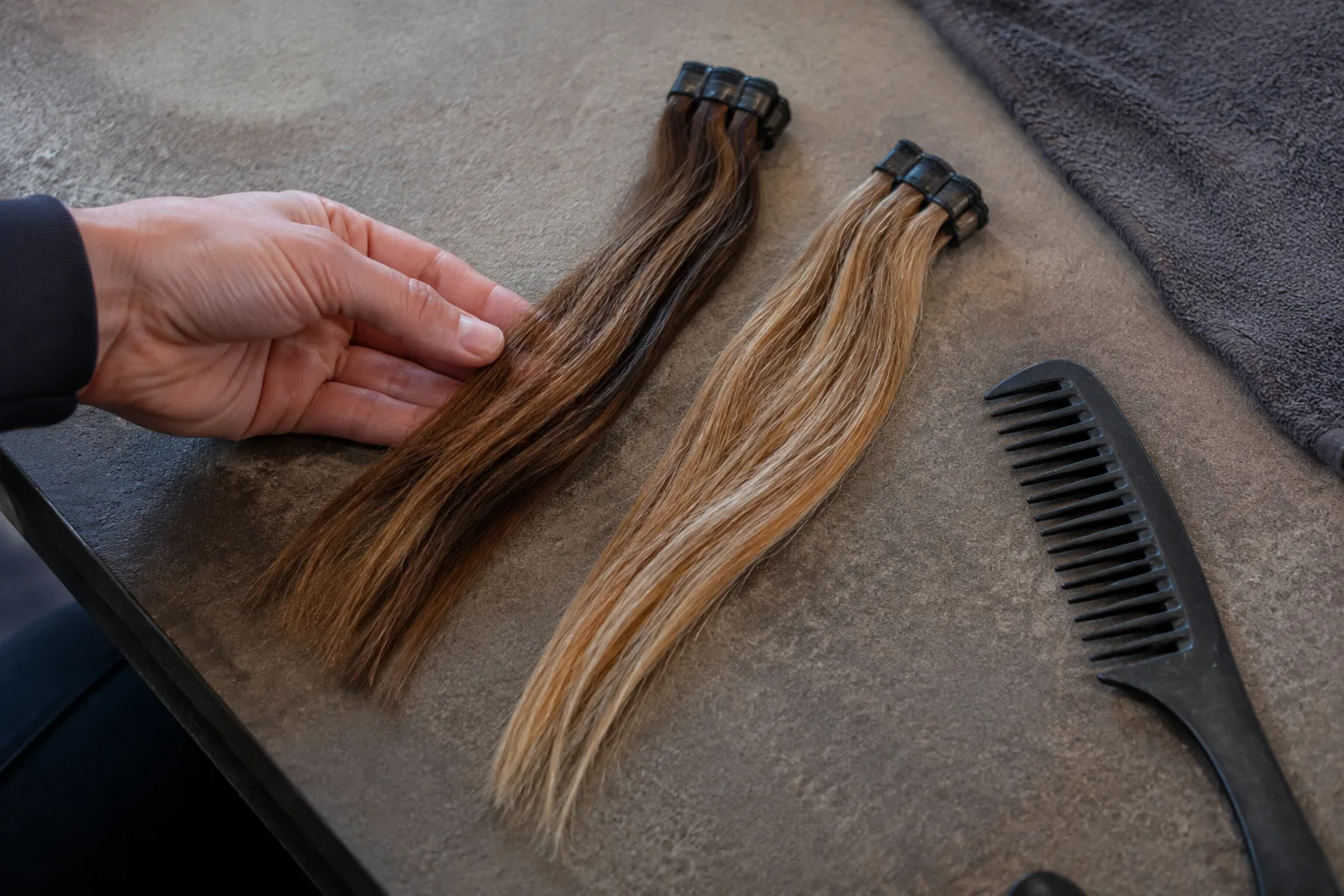
In professional hair-extension education, Remy is commonly tied to strand direction: the roots and tips remain oriented the same way, helping the cuticles lie in a consistent direction.
Why does that matter? Hair fibers rubbing against one another in opposing directions can behave differently from fibers aligned in the same direction. Scientific work on hair friction supports the importance of cuticle direction, but a product label alone does not prove how a commercial batch was collected or sorted.
This is also why Remy and unprocessed are not synonyms. Hair can be directionally aligned and still have a processing history. Ask both questions separately.
What virgin hair usually means
Virgin usually refers to processing history. In the market, it often means hair that has not previously been chemically colored, bleached, permed or relaxed.
The problem is that the exact boundary is not standardized across every seller. One supplier may allow washing and steam shaping within its definition; another may use a stricter interpretation. A buyer who plans a light blonde or hand-painted color should therefore request the actual batch specification and test the intended result instead of relying on the word virgin.
Virgin also does not automatically answer these questions:
- Are the strands kept root to tip?
- Is the batch single-donor or multi-donor?
- Has dark color been added to create a more uniform starting shade?
- How consistent are the lengths and ends?
- How will this batch respond to the buyer's planned color direction?
Those are separate buying checks.
What raw hair usually means
Raw hair is generally sold as hair with no chemical processing or only limited handling before sale. Many suppliers also connect the term with natural texture and donor traceability.
There is no single public certification that makes every raw hair listing equivalent. Claims such as “raw always means one donor,” “raw always lasts a fixed number of years” or “raw can always reach the same blonde level” go beyond what the label can establish.
For a B2B buyer, raw is best treated as the start of a specification conversation. Ask what the supplier means, what has been done to the hair, and what evidence is available for the batch you will actually receive.
Why sellers disagree about the same words
The human-hair trade has no universal retail dictionary enforced across every manufacturer, wholesaler and marketplace. Some labels describe collection. Others describe processing. Marketing pages often compress both into a single quality claim.
That creates familiar contradictions: one page says all virgin hair is Remy, another says it is not; one seller requires raw hair to be single-donor, another does not. Turning these disagreements into a fixed grade pyramid makes a clean graphic, but it does not give a buyer a reliable purchasing method.
A written brief and a physical sample are more useful than a hierarchy copied from a supplier blog.
Compare hair on three independent axes
1. Strand direction and cuticle condition
Ask how the strands are collected, sorted and kept in direction. Then inspect the sample for tangling behavior, shedding, short returns and the condition of the finished hair after normal handling.
Do not try to prove microscopic cuticle claims from a glossy product photo. If a particular technical claim matters to a larger order, request the supplier's test method or arrange independent testing.
2. Processing history
Ask whether the hair has been colored, coated, acid-treated, permed, steam-shaped or otherwise processed before it reaches the wig-color stage. The answer matters because a previous process can change how a new color service behaves.
For a hand-painted balayage wig, judge the finished result too: root depth, ribbon placement, tone, dryness, elasticity and the way the color reads in ordinary light.
3. Donor and batch traceability
Ask whether donor or batch claims are documented and how consistency is controlled between a paid test order and a later production order. Traceability does not remove natural variation, but it gives the buyer a clearer basis for approval and reorder discussion.
What the labels do not tell you about a finished wig
Even an accurate material label cannot describe the whole product. A finished wig also depends on:
- the hair grade accepted for that build;
- lace material, lace area and cap construction;
- knot work and hairline finishing;
- density and length distribution;
- the starting hair condition before color;
- color mapping, lightening, toning and rinse control;
- styling, packing and final inspection.
That is why two wigs with the same headline hair label can look and behave differently.
How to check a paid wig sample
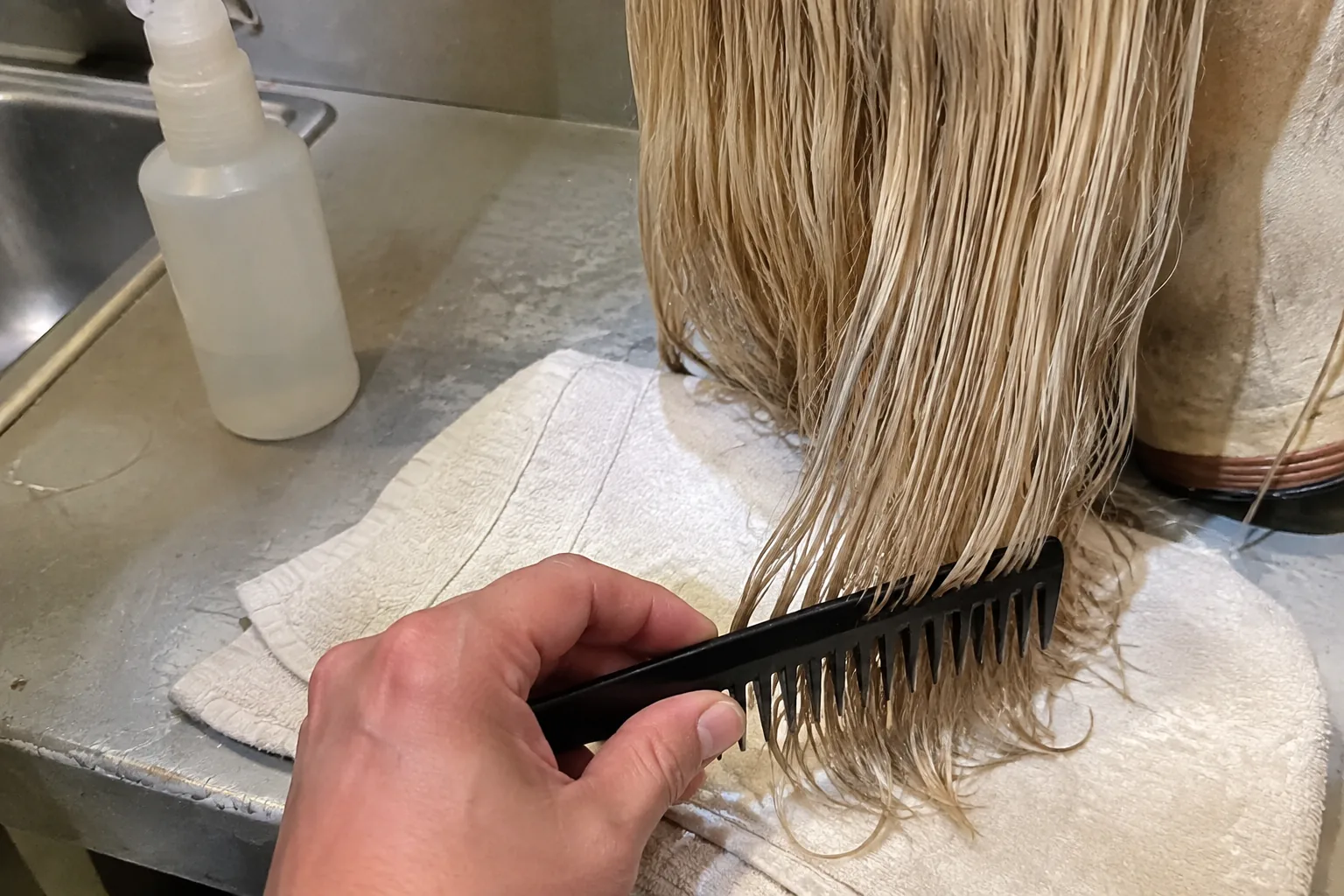
Keep the test practical and repeatable. Record the same observations for each sample rather than changing the test whenever a new vendor appears.
- Confirm the written material description and the meaning of each label.
- Photograph the unit in daylight, indoor light and the selling environment.
- Compare root depth, money-piece width and ribbon placement with the approved reference.
- Inspect the parting, knots, hairline and cap construction at close range.
- Handle the hair gently from ends upward and record tangling or unusual shedding without staging an aggressive “stress test.”
- Follow the agreed wash and care method, then note texture, dryness and color movement.
- Compare the actual length, density and finish with the written brief.
- Save the approved photos and notes as the reorder reference.
For a more detailed visual scorecard, use How to Check a Hand-Painted Balayage Wig Sample.
Questions to send a supplier before production
The most useful follow-up is about the hair at two stages: what condition it was in before coloring, and what color work was carried out to reach your chosen result. Keep that explanation with the approved sample so a later order refers to the same material and finish.
What Superior Raw Hair means on this website
NUSFACE uses Superior Raw Hair for its featured hand-painted balayage wigs. When choosing a finished blonde or highlighted piece, review the softness, ends, color placement and construction of that piece alongside the material description.
The current featured brief also lists 14, 16, 18, 20, 22, 24, 26 and 28-inch lengths, 5×5, 13×4 or 13×6 lace, and 180% density. NUSFACE can discuss other wig categories, components and custom options after reviewing the buyer's request. Availability, price and preparation time are confirmed in the written brief and quotation.
Our seven quality checks cover Hair Grade, Base Build, Tone Map, Hand Paint, Color Check, Lace & Knots and Final Pack. These checks assess the material, color and construction of your finished wig. Ask the team to explain the material specified for your order.
Frequently asked buyer questions
Is raw hair always better than virgin or Remy hair?
No universal label can answer that for every order. Define the term, inspect the sample and judge the finished wig against the intended use.
Does Remy mean the hair has never been colored?
Not necessarily. Remy commonly refers to strand direction and cuticle alignment, while prior chemical processing is a separate question.
Is all raw hair single-donor?
Do not assume it. Some sellers include single-donor origin in their definition; others use raw more broadly. Ask for the supplier's written meaning and available traceability.
Can a label guarantee how light the hair will lift?
No. Starting color, previous processing, fiber condition and the color system all matter. Approve the intended finished color through a paid sample rather than relying on a generic lift promise.
Can NUSFACE discuss hair or wig options beyond the featured balayage specification?
Yes. We also offer other human hair wigs, components and accessories. Tell us what you need so we can confirm the options and quote.
Turn the label into a testable brief
Open Custom Service and send the target wig type, material expectation, color reference, length, lace, density, quantity, packaging request and destination. If the request extends beyond the featured balayage specification, the business team can review it as a custom requirement.
Or start on WhatsApp. Ask the team to define the material wording in the written quotation before you approve a paid test order.
YOUR NEXT STEP
Get a quote for your color brief.
Send the reference, length, lace, density and quantity. Our team will confirm the details for your custom order.